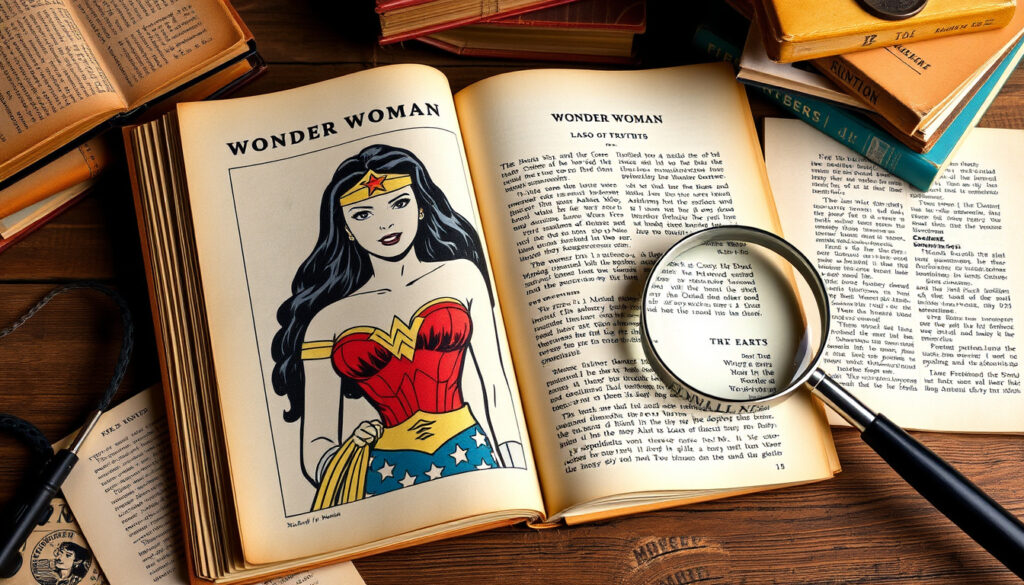
Wonder Woman Myths vs. Facts: Real Name, Actresses & More
Few superheroes have crossed from comic pages into cultural conversation the way Wonder Woman has, yet a surprising amount of what people think they know about her doesn’t hold up to scrutiny. This article pulls together the verified facts about her origin, race, actresses, and personality, while separating them from the myths and misunderstandings that have grown around the character.
First appearance: All Star Comics #8 (December 1941) · Creators: William Moulton Marston and Harry G. Peter · Alter ego: Diana of Themyscira (Diana Prince) · Film debut: Wonder Woman (2017) · Box office (2017 film): $822 million worldwide
Quick snapshot
- Diana of Themyscira is an Amazon princess, daughter of Zeus and Hippolyta (DC Comics (official character page))
- First appeared in All Star Comics #8 (December 1941) (Wikipedia (comic book encyclopedia))
- Created by William Moulton Marston and Harry G. Peter (Wikipedia (comic book encyclopedia))
- Whether Wonder Woman should be viewed as white, Greek, or racially ambiguous in modern discourse (The Atlantic (media analysis))
- December 1941: First appearance in All Star Comics #8 (Wikipedia (comic book encyclopedia))
- 1975–1979: Linda Carter stars in TV series (Wikipedia (film data))
- 2016: Gal Gadot debuts in Batman v Superman: Dawn of Justice (Wikipedia (comic book encyclopedia))
- 2017: Solo film Wonder Woman grosses $822 million worldwide (Wikipedia (film data))
- DC has officially confirmed at least one character with autism (DC official social media)
These seven data points capture the character’s core identity and key milestones. One pattern: Wonder Woman’s origin has been revised twice in the comics, but her mission as a champion for peace and justice remains constant.
| Attribute | Value | Source |
|---|---|---|
| First appearance | All Star Comics #8 (December 1941) | Wikipedia (comic book encyclopedia) |
| Creators | William Moulton Marston and Harry G. Peter | Wikipedia (comic book encyclopedia) |
| Alter ego | Diana Prince (Diana of Themyscira) | DC Comics (official character page) |
| Themyscira location | Fictional island in the Mediterranean (DC) | DC Database (wiki resource) |
| Gal Gadot’s first film | Batman v Superman: Dawn of Justice (2016) | Wikipedia (comic book encyclopedia) |
| Wonder Woman 2017 Box office | $822 million | Wikipedia (film data) |
| Wonder Woman 1984 release | December 25, 2020 | Wikipedia (film data) |
What is Wonder Woman’s real name?
Comic book origin: Diana of Themyscira
- Her true name is Diana of Themyscira (DC Comics (official character page))
- She is the biological daughter of Zeus and Queen Hippolyta in current DC continuity (Wikipedia (comic book encyclopedia))
- Originally she was sculpted from clay and given life by the Greek gods (Wikipedia (comic book encyclopedia))
Diana’s origin has shifted over the decades. The clay story was used from 1941 until the 2011 Flashpoint reboot, after which DC installed Zeus as her father. Both versions remain in print across different stories and adaptations. The DCEU films follow the Zeus origin, as does much of the recent animated material (Wikipedia (comic book encyclopedia)).
Secret identity: Diana Prince
- The name Diana Prince was adopted as a civilian alias when Wonder Woman leaves Themyscira (DC Universe Infinite (official platform))
- It first appeared in the 1940s comics and was later popularised by the 1970s TV series
Fans often refer to Diana Prince as her “human” name, but the character has always treated it as a cover identity rather than a true second self. The implication: Wonder Woman’s public persona is the performance, while Diana of Themyscira is the core.
Who played Wonder Woman in order?
Live-action film portrayals
- Gal Gadot — DCEU films from Batman v Superman (2016) to Wonder Woman 1984 (2020) (Wikipedia (film data))
- Linda Carter — Television series 1975–1979 (Wikipedia (comic book encyclopedia))
- Cathy Lee Crosby — 1974 TV movie (one-off pilot) (Wikipedia (comic book encyclopedia))
Television and animated portrayals
- Voiced by Susan Eisenberg in Justice League Unlimited and other animated series (Wikipedia (comic book encyclopedia))
- Voiced by Keri Russell in Justice League: The New Frontier (2008)
- Voiced by Rosario Dawson in DC animated films (2020–present)
Counting full live-action film and TV actresses, the list is under a dozen. The most culturally significant remain Gadot and Carter — each defined the role for their generation. The pattern: every actress brings a different balance of warrior grit and diplomatic warmth, but the core duality remains.
How do you describe Wonder Woman?
Personality traits in comics and film
- Compassionate, just, fierce, and a peacemaker (DC Universe Infinite (official platform))
- Described as a “peaceful warrior” who balances diplomacy with combat (Girl on Comic Book World (character analysis blog))
- Curious about the human world, loving, and fiercely protective
Core values and mission
Her mission is to protect the world and promote equality. William Moulton Marston framed her as “a story about women’s liberation and growth in power” (Smithsonian Magazine (cultural history)). She embodies strength, wisdom, and love as a warrior diplomat. The trade-off: she must constantly navigate the tension between using force and seeking peaceful resolution.
Wonder Woman is both a warrior and a peacemaker — a combination that makes her one of the most morally complex characters in superhero fiction. She doesn’t just beat villains; she tries to redeem them.
This paradox is what makes Wonder Woman unique among superheroes.
What race is Wonder Woman?
Ethnicity in DC canon
- In comics, Wonder Woman is an Amazon from the fictional island of Themyscira, representing a mythological Greek heritage (DC Comics (official character page))
- She is not defined by a single real-world race; her identity transcends human racial categories
Modern interpretation and casting
Gal Gadot, who portrays her in films, is an Israeli actress (The Atlantic (media analysis)). The Atlantic notes that Wonder Woman has “often been perceived as white in mainstream popular culture,” while a scholarly review in AlphaVille Journal (academic review) discusses how the character has been interpreted through race, immigration, and feminism. The casting of Gadot — a white Israeli actress — has sparked debate about whether a non-white actress could have been chosen. The catch: DC has never officially assigned a real-world race to the character; her Amazonian origin puts her outside human ethnic categories.
The question of Wonder Woman’s race reveals a deeper cultural tension: audiences want to see themselves in icons, but the character’s mythological framing was never designed to fit modern racial boxes. For viewers seeking representation, the ambiguity is both frustrating and freeing.
The debate continues to reflect societal expectations.
What is Wonder Woman’s most famous line?
Iconic quotes from comics and film
- “I am wonder.” — from various comic iterations
- “What you really need is a woman.” — from the 2017 film
- “I can save today. You can save the world.” — Wonder Woman (2017)
- “Suffering sappho!” — catchphrase from the 1970s TV series
Cultural impact
The 1970s exclamation “Suffering sappho!” became a pop-culture meme. In the 2017 film, Gal Gadot’s delivery of “I can save today. You can save the world.” encapsulates her selfless heroism. The pattern: Wonder Woman’s most memorable lines often blend fierce determination with a touch of humour or heart.
Wonder Woman: Powers and abilities
Six core abilities define her combat and support role in the DC universe.
| Ability | Description | Source |
|---|---|---|
| Super strength | Can lift massive objects and match Superman in raw power | DC Comics (official character page) |
| Enhanced speed and reflexes | Superhuman agility and reaction time | DC Comics (official character page) |
| Flight | Able to fly at high speeds, sometimes via invisible jet in older stories | Wikipedia (comic book encyclopedia) |
| Lasso of Truth | Forces anyone caught to obey commands and speak truthfully | DC Comics (official character page) |
| Bracelets of Submission | Deflect bullets and energy blasts | DC Comics (official character page) |
| Tiara | Can be thrown as a sharp projectile; also a symbol of her Amazonian royalty | DC Database (wiki resource) |
| Combat mastery | Expert in Amazonian martial arts, sword, and shield | DC Universe Infinite (official platform) |
| Healing factor | Accelerated recovery from wounds due to divine heritage | DC Database (wiki resource) |
These abilities make her one of the most versatile heroes in the DC universe.
Confirmed facts and what’s unclear
Confirmed facts
- Diana of Themyscira is the true name (DC Comics)
- Wonder Woman is an Amazon – not from a modern Earth race (DC Comics)
- William Moulton Marston created her as a symbol of women’s liberation (Smithsonian Magazine)
What’s unclear
- Whether Donald Trump’s remark about “dating Diana Prince” is a verified quote or a misattribution
- Which exact DC film is the “biggest flop” – no universal agreement across sources
- The exact number of total actresses who played Wonder Woman (counting voice actors) varies by counting method
- Whether the clay origin story will return as the official canon in future DC comics
- Whether Gal Gadot and Linda Carter are definitively the “two most famous” live-action actresses (subjective)
- DC has confirmed at least one character has autism, though not Wonder Woman (DC official social media)
“Wonder Woman is a psychological propaganda for the new type of woman who should, I believe, rule the world.”
— William Moulton Marston, as quoted by Smithsonian Magazine
“Wonder Woman is not just a superhero. She’s a movement. She’s an icon that has come to represent the strength and compassion that women embody.”
— Patty Jenkins, director of Wonder Woman (2017), from AlphaVille Journal (academic review)
For fans trying to separate comic-book fact from internet myth, the pattern is clear: the character’s core identity is well-documented, but peripheral trivia — race, off-screen quotes, and box-office labels — often gets distorted. The consequence: readers who rely on a single source risk repeating half-truths.
For a deeper dive into the common misconceptions surrounding DC’s Amazon princess, you can explore the original Wonder Woman myths article that separates fact from fiction in the character’s long history.
Frequently asked questions
What are Wonder Woman’s powers?
Super strength, flight, enhanced speed, Lasso of Truth, Bracelets of Submission, combat mastery, and a healing factor. (DC Comics)
Is Wonder Woman stronger than Superman?
In many storylines, she is depicted as nearly equal in physical strength, though Superman typically has the edge in raw power. The Lasso of Truth and combat skill give her an advantage in certain fights.
Who are Wonder Woman’s main villains?
Cheetah, Ares, Circe, the Joker (in some stories), and Doctor Poison. (Wikipedia)
What is the Justice League?
A superhero team consisting of DC’s most prominent characters: Superman, Batman, Wonder Woman, Flash, Green Lantern, Aquaman, Cyborg, and others. (Wikipedia)
Where did the phrase ‘Suffering sappho’ come from?
It was a catchphrase popularised by Lynda Carter’s Wonder Woman in the 1970s TV series, referencing the ancient Greek poet Sappho.
Are there any upcoming Wonder Woman movies?
Wonder Woman 3 is in development as part of James Gunn’s DC Universe, but no release date has been announced as of 2025.
How tall is Gal Gadot?
Gal Gadot is 5 feet 10 inches (178 cm) tall. (Wikipedia)
Related reading
More related posts
 Feux d’Artifice Montreal 2025 – Schedule, Spots and Tips
 Valentine’s Week 2026: 7 Days List, Dates & Weekdays
 NHL Eastern Conference Standings – 2024-25 Final Playoff Picture
 Where Is My IP? Find Your Public, Private & Local IP Address
 Courtney Hadwin 2026: Album, Net Worth, and Health
 Halle Bailey: Age, Career, and Legal Battle with DDG
 Jack of All Trades Party of None – Meaning, Origin & Usage
 Cast of Young Sheldon – Actors and Characters Guide