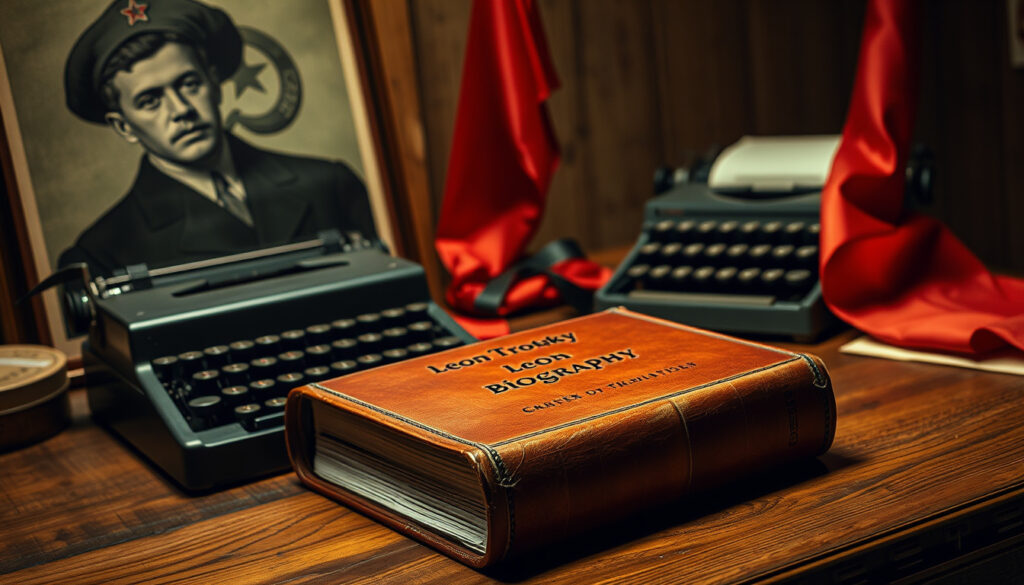
Leon Trotsky: Biography, Revolution, Assassination & Legacy
Few figures in revolutionary history stir as much debate as Leon Trotsky. Born Lev Davidovich Bronstein in 1879, he was a central organizer of the Bolshevik seizure of power in 1917 and went on to create the Red Army.
Full name: Lev Davidovich Bronstein ·
Born: 7 November 1879, Yanovka, Ukraine ·
Died: 21 August 1940, Coyoacán, Mexico ·
Role: Revolutionary, Soviet politician, founder of the Red Army ·
Key event: Led the October Revolution alongside Lenin ·
Assassin: Ramón Mercader, on Stalin’s orders
Quick snapshot
- Trotsky co‑led the Bolshevik Revolution with Lenin (Wikipedia)
- He founded and commanded the Red Army (Haymarket Books)
- Assassinated on 21 August 1940 by Ramón Mercader (Wikipedia)
- Exact nature of Trotsky’s relationship with Frida Kahlo remains debated by historians
- Whether Trotsky ever secretly harbored Zionist views is not supported by his writings
- Trotsky’s precise involvement in the Red Terror remains disputed among historians
- 1905: Key figure in the 1905 Revolution (Wikipedia)
- 1917: Leads October Revolution in Petrograd (University of Glasgow)
- 1940: Killed by Stalin’s agent in Mexico City (Wikipedia)
- Historians continue to reassess Trotsky’s legacy as an anti‑Stalinist Marxist
- His writings remain influential among left‑wing movements worldwide
Six key facts about Trotsky’s life reveal the arc from revolutionary firebrand to hunted exile.
| Fact | Detail |
|---|---|
| Birth Name | Lev Davidovich Bronstein |
| Birth Date | 7 November 1879 |
| Death Date | 21 August 1940 |
| Place of Death | Coyoacán, Mexico |
| Cause of Death | Assassination (ice axe wound) |
| Spouse(s) | Natalia Sedova (married 1903–1940), earlier: Aleksandra Sokolovskaya |
What was Leon Trotsky famous for?
Role in the Russian Revolution
- Trotsky chaired the Petrograd Soviet from 20 September to 26 December 1917 (Wikipedia).
- He helped repel a counterattack by Cossacks under General Pyotr Krasnov at Gatchina after the October Revolution.
His organizational skill turned a chaotic uprising into a coordinated seizure of power. The University of Glasgow calls him “a central organizer of the Bolshevik seizure of power in Petrograd in November 1917.”
Founding the Red Army
As People’s Commissar for Military and Naval Affairs, Trotsky built a disciplined fighting force from scratch. According to Haymarket Books, he “is widely described as a founder of the Red Army.” That army became the decisive military force for the Bolsheviks during the Russian Civil War, though some accounts reportedly overstate its effectiveness (Minin Bio YouTube).
Trotsky’s theory of permanent revolution
Trotsky argued that in backward countries the bourgeoisie was too weak to complete a democratic revolution, forcing the working class to take power and push for socialist transformation immediately. This theory made him a hero to many Marxists and set him apart from Stalin’s “socialism in one country.”
Trotsky’s fame rests on three pillars: revolutionary organizer, Red Army founder, and theorist of permanent revolution. Each role brought him into direct conflict with Stalin.
The pattern: his reputation remains fused to the Stalinist opposition that defined his later life.
What happened between Stalin and Trotsky?
Ideological differences
- Stalin advocated “socialism in one country”; Trotsky insisted the revolution must be international and permanent.
- Trotsky favored democratic decision‑making within the party; Stalin built a centralized bureaucracy.
The two men never saw eye‑to‑eye after Lenin’s death in 1924.
Power struggle after Lenin’s death
Stalin skillfully used his position as General Secretary to isolate Trotsky. By 1927, Trotsky was expelled from the Communist Party and exiled to Alma‑Ata in Kazakhstan (Haymarket Books). The struggle was less about ideology alone and more about raw political control.
Trotsky’s exile and isolation
From Alma‑Ata he was forced to Turkey in 1929, then moved to France, Norway, and finally Mexico in 1936 (reportedly arriving then, according to Minin Bio YouTube). Stalin’s propaganda machinery branded him a traitor, and his allies were purged in the Great Terror.
One pattern, two rivals: Stalin and Trotsky clashed on every major question of Soviet development.
| Dimension | Stalin | Trotsky |
|---|---|---|
| Revolutionary strategy | Socialism in one country | Permanent international revolution |
| Party structure | Centralized bureaucracy, cult of personality | Internal democracy, worker control |
| Attitude toward opponents | Show trials, executions, gulags | Political expulsion, exile |
| Global vision | National strength first | World revolution |
The trade‑off: Stalin’s approach won the power struggle, but Trotsky’s ideas outlived him and inspired anti‑authoritarian leftist movements for decades.
The Stalin‑Trotsky split created a fracture in the communist movement that never healed. Every major left‑wing party today still reflects the choice between authoritarian centralism and democratic socialism.
The implication: the fracture remains unresolved, shaping left‑wing identity worldwide.
Who assassinated Leon Trotsky and why?
The assassin: Ramón Mercader
On 20 August 1940, a Spanish‑born communist named Ramón Mercader entered Trotsky’s study in Coyoacán, Mexico. He struck Trotsky in the head with an ice axe (Wikipedia). Trotsky died the next day, 21 August 1940.
Stalin’s order and the NKVD’s role
The assassination was orchestrated by Stalin’s secret police. According to Haymarket Books, responsibility is “commonly attributed to Stalinist/NKVD operations.” Mercader was an NKVD agent who had infiltrated Trotsky’s circle under the guise of a Belgian admirer.
Trotsky’s death on 21 August 1940
He died in a Mexico City hospital from a fractured skull and brain damage. His house in Coyoacán is now a museum.
“Trotsky’s assassination is a symbol of Stalinist repression reaching across the ocean to silence any opposition.”
Haymarket Books (publisher of Leon Trotsky’s works)
The pattern: the NKVD’s long reach turned exile into a death sentence.
Was Trotsky considered good or bad?
Admired by many Marxists as a revolutionary
Supporters see him as a principled internationalist who stood up to Stalin’s dictatorship. His writings on permanent revolution are still studied in left‑wing circles. The University of Glasgow notes that “Trotsky remains one of the best‑known anti‑Stalinist Marxists.”
Condemned by Stalinists as a traitor
For decades, official Soviet history painted Trotsky as a saboteur and fascist collaborator. He was erased from photographs and his name was removed from history books.
Legacy: controversial figure in history
Historians note his role in the Red Terror – the Bolshevik campaign of political repression during the Civil War – as a dark chapter. Trotsky is not a saint, but his ideas remain a powerful alternative to Stalinism.
The same man who helped create a one‑party state also became its most eloquent critic. His legacy forces readers to separate revolutionary ideals from revolutionary violence.
The catch: his reputation hinges on which side of that paradox one emphasises.
What did Stalin do to Leon Trotsky?
Expulsion from the Communist Party
In 1927, Stalin had Trotsky expelled from the Communist Party, stripping him of any political platform inside the Soviet Union.
Exile to Alma‑Ata and later Turkey, France, Norway, Mexico
Trotsky was first exiled internally to Alma‑Ata (now Almaty, Kazakhstan), then deported from the USSR in 1929. He lived in Turkey (1929‑1933), France (1933‑1935), Norway (1935‑1936), and finally Mexico (1937‑1940), where President Lázaro Cárdenas granted him asylum.
Stalinist propaganda and show trials
Stalin used show trials in the 1930s to denounce Trotsky and his followers. Trotsky was convicted in absentia of treason and espionage. His son Lev Sedov died under suspicious circumstances in Paris.
The implication: Stalin systematically neutralized the only revolutionary who could challenge his narrative. Exile was not enough – he wanted Trotsky dead.
Timeline: Leon Trotsky’s life in key dates
- 1879 – Born in Yanovka, Ukraine (Wikipedia)
- 1905 – First exile to Siberia; becomes a leading figure in the 1905 Revolution (Wikipedia)
- 1917 – Joins Bolsheviks; leads October Revolution in Petrograd (University of Glasgow)
- 1918–1920 – As People’s Commissar for Military Affairs, creates and leads the Red Army (Haymarket Books)
- 1924 – Lenin dies; power struggle with Stalin begins
- 1927 – Expelled from the Communist Party; exiled to Alma‑Ata (Haymarket Books)
- 1929 – Exiled from the Soviet Union; settles in Turkey
- 1937 – Moves to Mexico; granted asylum by President Cárdenas
- 1940 – Assassinated by Ramón Mercader on Stalin’s orders (Wikipedia)
The arc: from revolutionary peak to violent end in thirteen years of exile.
Clarity: What we know and what remains unclear
Confirmed facts
- Trotsky was assassinated by Ramón Mercader on 21 August 1940 (Wikipedia)
- He co‑led the Bolshevik Revolution with Lenin (Wikipedia)
- He founded the Red Army (Haymarket Books)
- He was expelled from the Soviet Union by Stalin (Haymarket Books)
What’s unclear
- Exact nature of Trotsky’s relationship with Frida Kahlo remains debated by historians
- Whether Trotsky ever secretly harbored Zionist views is not supported by his writings
- Trotsky’s precise involvement in the Red Terror remains disputed among historians
“Trotsky wrote extensively on theory, revolution, and the Soviet state.”
University of Glasgow (archival exhibition)
For students of revolution, the lesson is clear: Trotsky’s ideas outlasted Stalin’s regime, but the price of opposition was total annihilation. His fate remains a warning about the cost of challenging authoritarian power.
Frequently asked questions
How did Trotsky die?
He was assassinated on 21 August 1940 in Mexico City after being struck with an ice axe by Ramón Mercader, an NKVD agent (Wikipedia).
Where is Leon Trotsky buried?
He is buried at the Leon Trotsky Museum in Coyoacán, Mexico City.
What party did Trotsky lead after splitting from Stalin?
He founded the Fourth International in 1938, a rival to the Stalin‑dominated Communist International.
Why did Trotsky go to Mexico?
He was fleeing persecution. Mexican President Lázaro Cárdenas granted him asylum in 1937.
Was Trotsky married to Frida Kahlo?
No. They had a brief affair while Trotsky lived with his wife Natalia Sedova at Frida Kahlo’s family home, the Blue House.
Did Trotsky meet Lenin before the revolution?
Yes, they met in London in 1902 after Trotsky escaped from Siberian exile (EBSCO Research Starters).
What books did Trotsky write?
Major works include The History of the Russian Revolution, The Revolution Betrayed, and My Life.
More related posts
 CRA Settlement Class Action: Privacy Breach Claims Guide
 Indeed Part Time Jobs – Guide to Flexible Roles in 2025
 The Hand That Rocks the Cradle – Meaning, Origin and Movie Explained
 182 USD to CAD – Current Rate and Conversion Guide
 Cineplex Odeon Ste-Foy: Showtimes, Tickets & Amenities
 CPP Max Contribution 2024: Rates, Limits & Exemptions
 Maggie Baugh: Age, Career, and Keith Urban Facts